Wednesday, December 13, 2023

Leonard Cline Reviews CHALK FACE (1924) by Waldo Frank

Cline's review of Waldo Frank's odd novel Chalk Face appeared on the book page at the St. Louis Post-Dispatch, while Cline was on the staff there, on 18 October 1924. 

Waldo Frank Essays Modern Ghost Story

There is a sense of madness and at the same time a drug-like ecstasy always in the strange style of Waldo Frank. His sentences come twisted in baroque convolutions, with ellipses that have the effect of suspending one in the folds of mist. His mental processes, too, are almost convulsed; his associations are strained and chaotic and lead to traumatic metaphors. Ordinarilly, as in Rehab, one can hardly follow the story because one is absorbed in the style; but when, in Chalk Face, he attempts horror, style and matter are in agreement.

Chalk Face is a striking book. Here is a ghoulish thesis: that  a man by the creative force of his own passions can create a “larval man,” a monster with hands material enough to plunge a blade and yet with body spiritual enough to “plane” horribly through the air “like a bird of prey”; and that this man will go about through streets and corridors to do murder. “Chalk Face” is such a man, a modernist ghost.

On this foundation is built the chronicle of the struggle of Dr. John Mark. Two inexplicable murders, each of them calculated to further his own interest, throw him, already tortured mentally by a baffled love, into morbid brooding. On the suspicion that the murderer is something psychic, Mark determines to pursue him by psychic means, He shuts himself in his rooms, he denies himself tobacco or stimulants, he eats frugally of vegetables and fruit and he compels his feeling brain to thrust out the body into whatever spiritual plane of existence there may be. It is a curious chapter. Just so do theosophists discipline themselves to expect the hallucinations that surely must follow. And so, in the end, Mark confronts the murderer.

Of the stock articifes of the writer of horror stories, Waldo Frank uses several with success. There is gripping suspense after that interview of Mark’s with Mrs. Landsdowne, the clairvoyant, when she recoils from him, terror-smitten, and whispers, “What are you doing now?” The setting for the final episode with Chalk Face, the dreary ploughed field sloping to the slime of a lime kiln, is as grewsome as Poe’s dank tarn of Auber.

Chalk Face will serve at least as an introduction for Waldo Frank into the company of the really great writers of horror who are publishing these days. It is hardly as original a conception as the revolt of the beasts in Arthur Machen’s The Terror, or as that furtive thing of the Canadian wilderness in Algernon Blackwood’s “The Wendigo.” But it is certainly an achievement , and will find an interested audience, particularly among students of psychology. (Boni & Liveright.)

I read Chalk Face several years ago  Here is the main thrust of my review, which is more critical than Cline’s. It appears in my collection Late Reviews (2018):

I found it irritating and long-winded, with a central idea that might have been interesting if handled very differently. It is the first person narrative of one Dr. John Mark, who is writing his story in order to escape from his own “eternal Twilight” and to “dwell once more in the innocent world of men: in the world where the sun is luminous because the night is black, where life seems good because death is real.” This novel is filled with page after page of this kind of blather.

John Mark is a self-absorbed bore who pines after the woman of his dreams, Mildred Fayn. When he divulges his love to Mildred, she tells him of another suitor for her hand, Philip LaMotte, who is subsequently found dead, stabbed by a white-faced man. John Mark’s wealthy parents refuse to give him money to wed Mildred, and then they die in an auto accident, after which it is discovered that a chalk-faced man has interfered with the repair of their vehicle at the car shop. What this leads up to is that John Mark is so ambitious that his own will has embodied itself and killed off the people who would stand in the way of what his intellect wants. Mark slowly learns this, and then tells Mildred, who rejects him and believes him to be insane.

What makes this novel even more confusing is that most of it is written in an annoying present tense, though in many places it slips back and forth clumsily between the present and the past. This could possibly have been an interesting novel, but it is crippled by the style in which it is written, and the form in which the author chose to tell it. (p. 71)


Sunday, September 24, 2023

A Leonard Cline Disovery!

It has to be at least ten years since I found a new (to me) publication of anything by Leonard Cline, so I was overjoyed to find that Cline had given a choice blurb for a book published by his own publisher, the Viking Press. The book is Roots by Eduardo Zamacois, translated from the Spanish (the book had appeared in 1927 as Las Raices). The translation is uncredited, but the UK edition of 1930 (and Viking's own renewal of copyright as a work-for-hire in 1957) gives the translator as Eliseo Vivas (1901-1991).  (Interestingly, the translation does not appear in Hugh Mercer Cartler's Eliseo Vivas: An Annotated Bibliography (1981), where it would have figured as one of his earliest publications.)

Cline had died in January 1929, while the Zamacois book was not published until late October 1929, so Cline's comments probably date from sometime in 1928.  Eduardo Zamacois (1873-1971) was born in Cuba, but left at the age of four, living in Belgium, France and Spain, until after the fall of Barcelona in early 1939, he fled to France, the U.S., and Mexico, before he settled finally in Argentina. He was a prolific writer, though little of his work has been translated into English. 

The striking dust-wrapper illustration is by Paul Wenck (1892-1964), a German commercial artist who emigrated with his wife to the US in 1923. Wenck is known for dust-wrapper art in the late 1920s for publishers including the Viking Press, Horace Liveright, and Little, Brown--notably for the latter's 1929 All Quiet on the Western Front by Erich Maria Remarque. Cline's blurb is on the rear--the only text anywhere describing the contents of the book itself (the book has no introduction, and advertisements for other publications on the flaps).


Wednesday, September 20, 2023

Leonard Cline and John Wilstach's ROPE NECKTIES

In my previous post, I noted that Leonard Cline and John Wilstach certainly knew each other by April 1928. The reason is that Cline sent a letter to Wilstach about his serial "Rope Neckties" that had appeared in three consecutive issues of Argosy All-Story Weekly, 21 April, 28 April, and 5 May 1928. We know this because when the novel was printed in book form, as Rope Neckties in 1939, Wilstach published a letter in Writer's Digest for September 1939, part of which reads:

Recently one of my old Argosy western series was published in book form by McBride, called Rope Neckties, with the nom de plume of John Van Buren. While it was serialized I received a letter from the late Leonard Cline, poet, critic, and novelist of note, praising part of the yarn and saying that pages 88-89 was a prose poem worthy of a French master. Reading it over in mag form I thought he was kidding. Now, rereading the same in book form, darned if I don't think he is right. Anyway, the dress has a lot to do with it all. 

The imprint on the 1939 volume is the Dodge Publishing Company, which was owned by the Robert M. McBride Company. The text to which Cline and Wilstach referred is as follows: 

If you have ever rode herd at night you’ll recollect that the cattle 'll move and stir about uneasy during the long hours from midnight on. There is always some sound. The sharp yelp of the coyote or the snorting and neighing of a pony half asleep on his feet, and wanting to go the rest of the way.

Sudden, just as you are about half dead in the saddle, hunched over, an’ a cigarette tastes bitter’n dust; when all you long fer is curl up on the ground and sleep, there comes a solemn pause that seems to say: “Hush, little doggies, be still.” There is quiet along the prairie—even the wind dies down—and, unconscious, you seen to be waiting for something beautiful to happen.

And dog-gone it, partner, something does. At that moment you is offered heaven on a silver platter. A gray veil pushes back those golden stars, there is a feeling of peace everywhere, and the sun, gentle like, lifts out of the east like a welcome.

Calling it "a prose poem worthy of a French master" does seem to be stretching it, but it is a nicely poetic scene in miniature. Rope Neckties was reprinted in 1948, back under Wilstach's own name, as a digest-sized paperback of the Hillman imprint "Novel Selections, Inc." It was no. 4 of the "Fighting Western Novel" series. See the cover, above right.

For assistance on this subject, I am grateful to John Locke, and to the late Denny Lien.

Saturday, September 16, 2023

The Mystery of the John Wilstach Letter on THE DARK CHAMBER

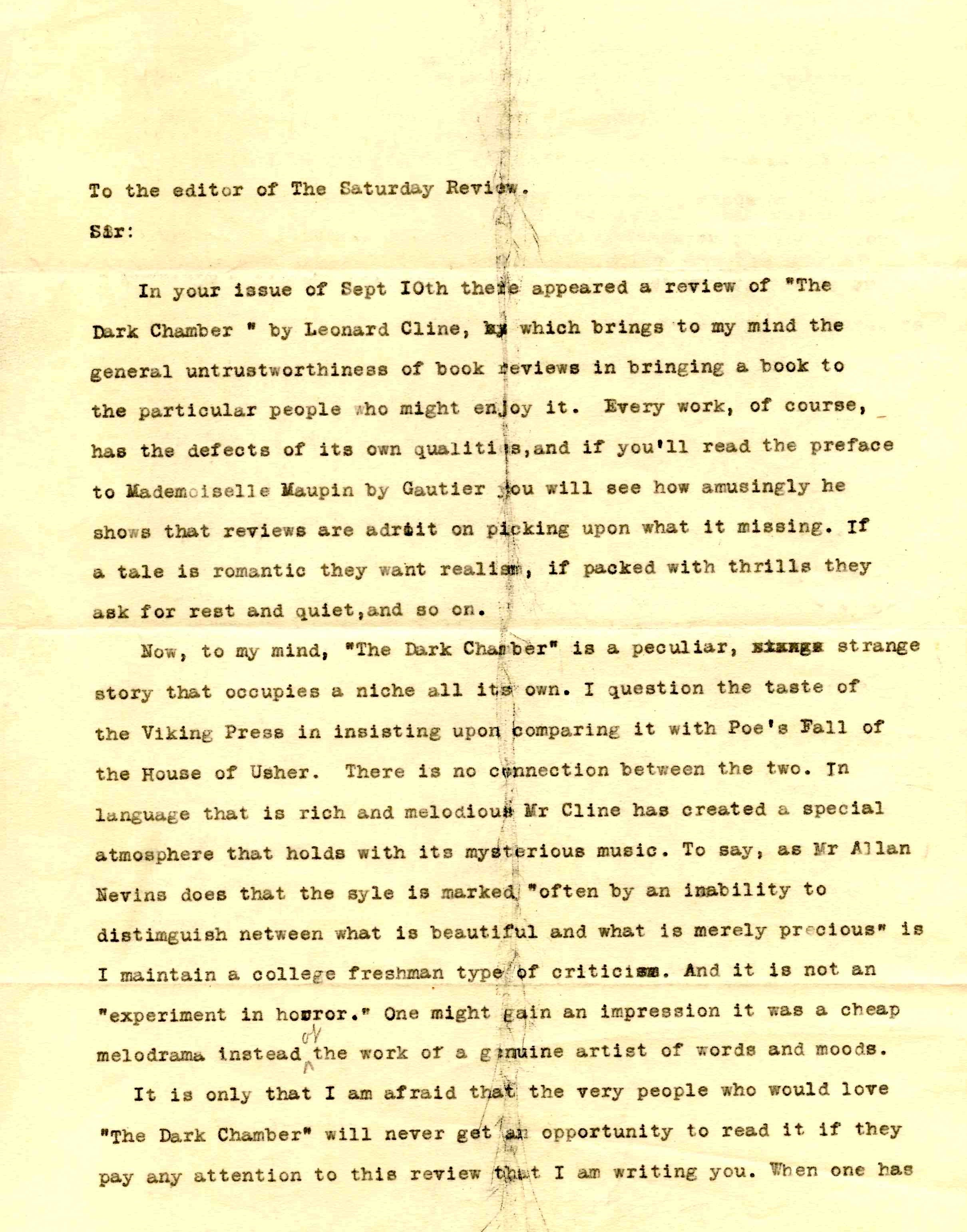
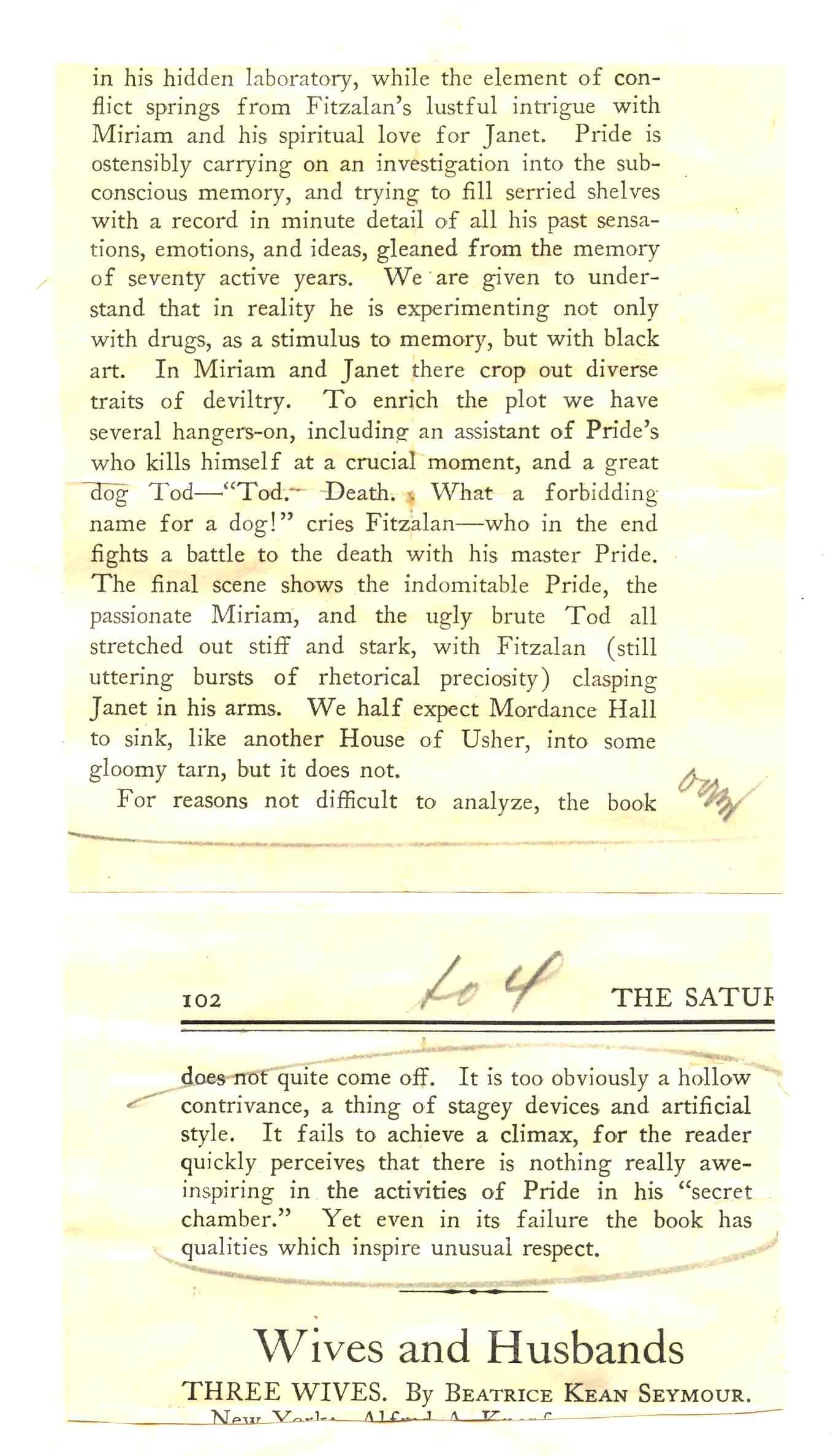
In the early 1990s, as I began exploring the papers of Leonard Cline, I found an interesting undated and unsigned carbon copy of a letter to The Saturday Review about their review of The Dark Chamber. Reading the letter, I thought at first that Cline himself might have written it, for the tone, and some of the sentiments, are similar to Cline's. Also, I had before me the review in The Saturday Review by Allan Nevins from Cline's own scrapbook, and noted that Cline himself had bracketed two comments, one of which is also quoted at length in the letter.   

The review itself appeared in the 10 September 1927 issue of The Saturday Review, and the letter of comment, signed as by John Wilstach, appeared in the 8 October issue. It didn't take much digging to realize that John Wilstach  (1890-1951), was a real person, a newspaper man who published stories prolifically and who also worked as a theatrical press agent. He must have moved in the same circles in New York as did Cline, and thus they likely knew each other by 1927 (they certainly knew each other by April 1928). So having penned his reply to the book review, Wilstach sent a carbon to Cline, then in jail in Tolland, Connecticut. 


I present here the letter carbon from Cline's papers, and and the review from Cline's scrapbook. (Click on the pictures to enlarge them.)